Canal days out: the complete guide
Canals are the slow lane of Britain's traction story. Before lorries, and before the railways got serious, coal, timber and grain moved at walking pace behind a horse, then behind a steam engine, along water that still runs through nearly every industrial town in the country.
The good news for a day out is that almost all of it is free to watch. Locks work, boats gather, horses pull, and nobody charges you to stand on a towpath. This guide covers the lot, from the big summer rallies to the strange winter treat of walking around inside a drained lock.
Boat rallies and festivals: what actually happens
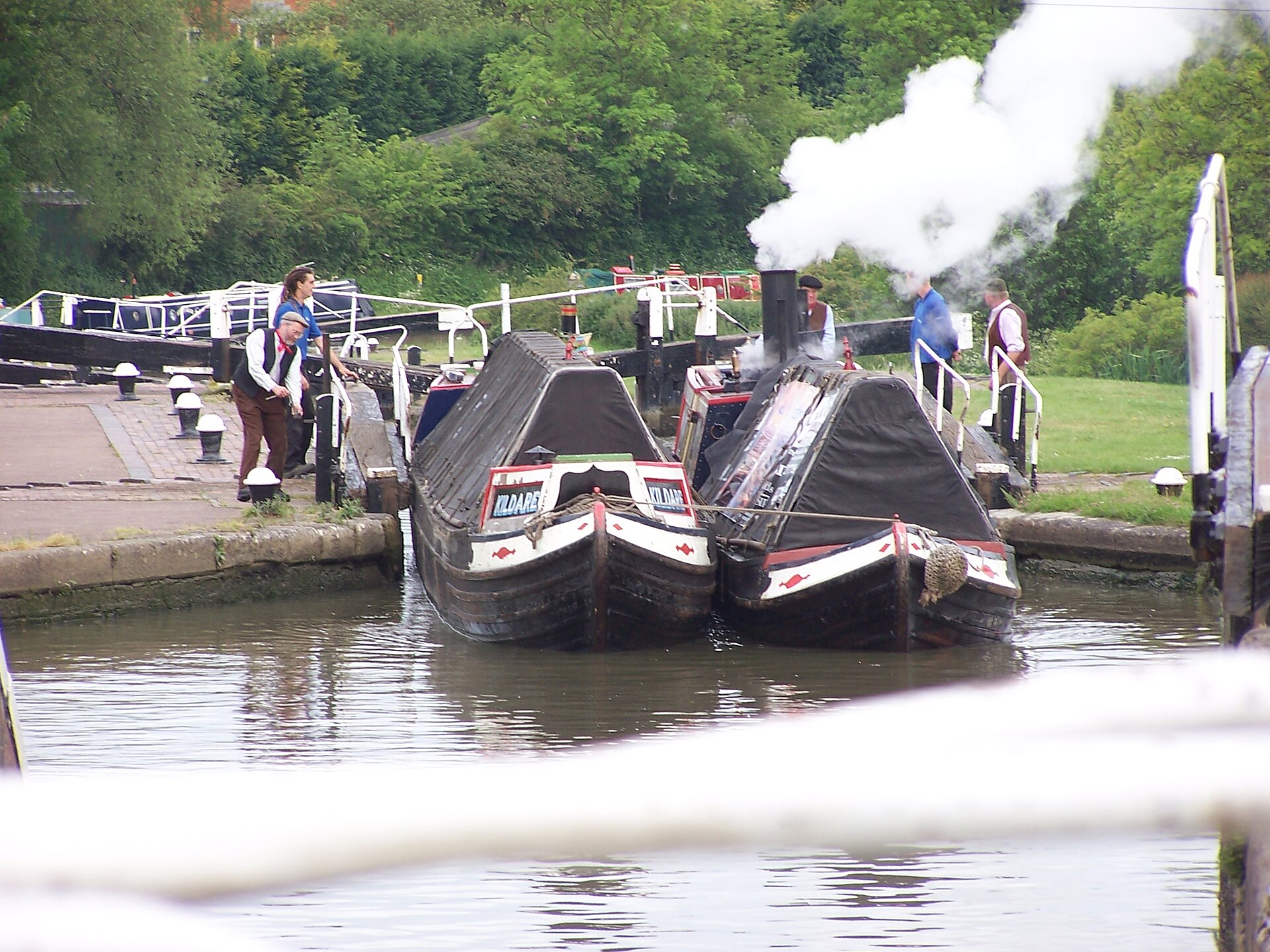
A boat rally is a gathering of working narrowboats, most of them 80 to 120 years old, moored gunwale to gunwale with their brasses polished and their engines ticking over. There are boat parades through the day, trade stalls, a beer tent and usually a brass band. The paintwork alone is worth the trip: roses and castles done properly, by hand, on boats that once carried coal.
The big one is the Braunston Historic Narrowboat Rally, held at Braunston Marina in Northamptonshire on the last full weekend of June (27 and 28 June in 2026, the rally's 22nd year). Braunston sits where the Grand Union meets the Oxford Canal and was once the crossroads of the working canal trade, so the setting does half the work. Around a hundred historic boats turn up, and the 2026 rally had the steam narrowboat President back in steam with her new boiler, with Pete Waterman opening proceedings.
If you want new boats rather than old ones, the Crick Boat Show near Daventry runs over the late May bank holiday weekend (23 to 25 May in 2026). It is the trade show of the canal world, useful if a rally has left you with dangerous ideas about buying one.
Practical notes: parking is usually a field, the towpath gets busy for the parades (morning and afternoon, check the programme on the day), and boat owners will happily talk engines for as long as you can stand there.
Lock open days: walk inside a drained lock
Every winter the Canal & River Trust drains sections of canal to replace lock gates, which last about 25 years and weigh several tonnes each. At an open day they put scaffold stairs into the empty chamber and let you walk down inside.
It is one of the best free days out in the country. You stand on a lock floor that normally sits under twelve feet of water, next to brickwork that boats have been bumping since the canal opened, while the engineers doing the work explain how it all fits together. Kids get to stand somewhere genuinely forbidden, which never fails.
The 2026/27 programme so far includes River Lock in Leeds in November, then Caen Hill near Devizes and Hatton in Warwickshire in February. Open days are free but run on booked timed slots, and the slots go quickly once announced. Wear wellies or proper boots; the bottom of a drained lock is exactly as muddy as you would hope.
Horse-drawn boats and steam boats
Before diesel, canal traction meant a horse on the towpath, and you can still ride behind one. Llangollen Wharf runs horse-drawn trips along the Dee valley, from 45-minute tasters up to a two-hour run to Horseshoe Falls. Tiverton Canal Co works the last horse-drawn barge in Devon along the Grand Western Canal, roughly April to October, and the Kennet Horse Boat Company does the same at Kintbury on the Kennet & Avon. All three need booking in school holidays. A boat at horse pace is silent apart from hooves and water, and it turns out plenty of people want exactly that.
Steam came to the canals too. President is a 1909 Fellows, Morton & Clayton steamer based at the Black Country Living Museum, and after a long boiler rebuild she is back in steam and out at rallies, including Braunston in 2026. If you spot a tall chimney and no engine clatter in the parade, that is her. Steam boats are rare enough that any rally with one on the list is worth rearranging plans for.
How to watch a lock flight without being in the way
A boat takes ten to fifteen minutes to work through a lock, so a busy flight on a summer Saturday is continuous slow theatre. Stand at a middle lock and one boat's entire journey passes you.
The rules of the pitch: stay on the towpath side, keep clear of the swing of the balance beams (the big white-tipped arms), and never cross a lock on the gates. Crews do it; they know where the grip is. Watch for the paddles being wound, the chamber filling, and the moment the gates lean open just as the levels equalise.
Offering to lean on a gate beam is usually welcome, and most crews will let kids push if an adult asks first. Winding paddles is different. That needs a windlass and someone who knows when to stop, so leave it to the crew unless invited.
Towpath etiquette and kids near water
The towpath is a shared workplace. Step over mooring ropes rather than on them, give anglers room at the moment of a cast, and never touch a rope on a boat that is working a lock. Cyclists are supposed to slow for people on foot; most do, and glaring at the rest is traditional.
For children, one rule does most of the work: you can see the water, you cannot touch it. Open towpath is flat, level and safer than most playgrounds. Lock sides are the real hazard, with sheer drops onto water or concrete, so hold hands within a boat's length of a chamber and keep dogs on short leads there.
Canal water is deep, cold and full of things you cannot see. If anyone does go in, the drill is out fast, warmed up and checked over, not embarrassed and hurried along.
The great canal spectacles
Caen Hill, Devizes. Twenty-nine locks lifting the Kennet & Avon 237 feet, with the famous straight flight of sixteen marching up the hillside. Boats take five to six hours to do the lot, so afternoons give the best towpath viewing. Cafe at the top, easy parking, pushchair-friendly path.
Foxton Locks, Leicestershire. Ten staircase locks in two sets of five, where each lock opens straight into the next. Beside them sit the earthworks of the 1900 inclined plane boat lift, a small museum and two pubs at the bottom. Probably the best single canal site in England for a family.
Anderton Boat Lift, Cheshire. The 1875 'cathedral of the canals' drops boats fifty feet from the Trent & Mersey to the River Weaver. Fair warning: the lift itself is out of action for caisson gate repairs until 2027, though the visitor centre is open and the Edwin Clark trip boat still cruises the Weaver. Check before travelling any distance.
The Falkirk Wheel. The world's only rotating boat lift, joining the Forth & Clyde and Union canals in Scotland. The trip boat rides the wheel most days and event days add plenty around the basin. Book the boat trip ahead in summer; watching from the basin costs nothing.
A canal year, month by month
The rough shape of the season: lock open days run November to February while the water is down. Horse-drawn trips start around April. Crick takes the late May bank holiday, Braunston takes the last weekend of June, and smaller rallies and floating markets fill the summer weekends. Steam boats appear wherever the rallies are.
Dates shift every year, which is rather the point of checking. TractionAction lists canal events by postcode, checked weekly, and the Thursday Runsheet flags what is coming up within striking distance. Wellies optional, except at lock open days, where they are the whole uniform.
Quick answers
Are canal days out free?
Mostly. Towpaths, lock flights and the big spectacles cost nothing to watch. Rallies charge a small entry or parking fee, lock open days are free but ticketed, and you only pay when you get on a boat.
When is the Braunston Historic Narrowboat Rally?
The last full weekend of June each year at Braunston Marina, Northamptonshire. In 2026 it ran on 27 and 28 June.
Is the Anderton Boat Lift open?
The visitor centre and the River Weaver trip boat are running, but the lift itself is closed for caisson gate repairs and is due back in service in 2027.
Do horse-drawn boat trips need booking?
In school holidays, yes. Llangollen Wharf and Tiverton Canal Co both take online bookings, and seasons run roughly April to October.
What should we wear to a lock open day?
Wellies or sturdy boots and clothes you do not mind getting muddy. The chamber floor is wet clay and the stairs are scaffold. Everything else is normal winter walking kit.