Digger days out: the family magnet guide
Nobody teaches small children to love diggers. It arrives pre-installed, somewhere around the age of two, and in a lot of us it never leaves. The difference between a toddler at a site fence and a fifty-year-old at a quarry working weekend is mostly height.
This guide covers the best of Britain's digger days out: a Lake District quarry where steam navvies built in 1909 still dig for real, the biggest preserved walking dragline in western Europe (she is called Oddball, and on the right day you can sit in her cab), the giant trade show where modern machinery works flat out for three days, and the parks where children drive the real thing.
Watching beats everything (ask any site hoarding)
Builders worked this out long ago. City site hoardings come with little perspex viewing windows because people were pressing their faces to the gaps anyway. A digger doing its job is one of the few bits of adult work that makes complete sense to a two-year-old: scoop, swing, dump, repeat, with the score kept in the size of the hole.
The trouble with the site fence is that you get thirty seconds before someone needs the toilet, and the machine is usually idle. The days out below fix that. They put you in front of machines that are genuinely working, and the single best filter when choosing one is the word "working" or "demonstration" in the event title. A parked digger is interesting for ten minutes. A digging digger holds a family for hours.
On TractionAction this all files under plant, the fourth leg of the brand alongside road, rail and water. Those three haul. Plant digs the stuff being hauled. Every load starts in a bucket.
Threlkeld Quarry: steam navvies digging for real
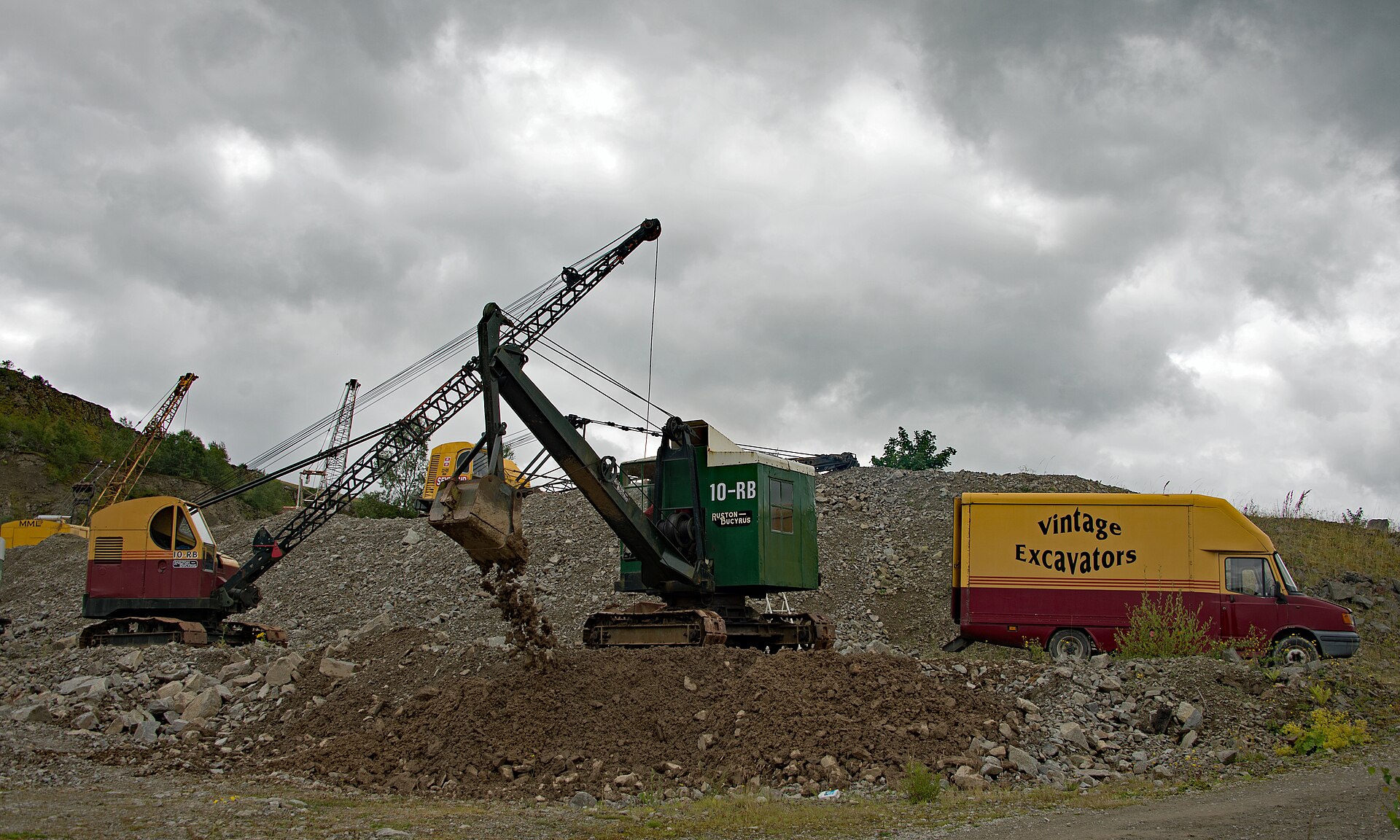
Threlkeld Quarry and Mining Museum sits just outside Keswick in the Lake District: a granite quarry with a mining museum, a narrow gauge railway and the home collection of the Vintage Excavator Trust, around 80 machines in states ranging from gleaming to gently rusting.
The star is Ruston Proctor No. 306, built in 1909, restored with Heritage Lottery help and claimed, credibly, as the world's oldest working excavator. It is a steam navvy: the machine that took over from the navvies who dug Britain's railways and docks by hand, and took their name while it was at it.
The working weekends are the reason to time your visit. The Trust runs two a year, and the autumn one falls on 19 and 20 September 2026 (the spring edition ran in mid May). These are not choreographed demos on a plinth. The machines dig the quarry floor because the quarry floor needs digging, buckets clanking and boilers sighing, while the railway runs a frequent service through the site and there is food and drink on hand. Wear proper boots. It is a quarry, and it behaves like one.
What a dragline is, and where to meet Oddball
A dragline is the excavator's giant cousin. Instead of a rigid arm it slings its bucket from a long boom on steel ropes, casts it out like a fisherman, then winches it back through the ground to fill. No hydraulics on the classics, just ropes, momentum and operator skill. Opencast coal mines used them to strip the rock and soil above the coal, and built them at a scale where machinery starts turning into architecture.
They are far too heavy for wheels or tracks, so they walk. The body sits on a huge circular tub, and two enormous steel shoes on eccentric gears lift the whole machine and shuffle it backwards a couple of metres per step. Top speed is measured in yards per hour, which is one reason nobody ever stole one.
The one to meet is Oddball, a Bucyrus-Erie BE1150 and the largest preserved walking dragline in western Europe. She stands at RSPB St Aidan's between Leeds and Castleford, on the opencast site she once dug, now a wetland reserve loud with bitterns rather than buckets. The Friends of St Aidan's open her up on regular open days through the year (dates at walkingdragline.org), when you can climb aboard and sit in the cab. Any other day the park is open you can still walk right up and feel properly small next to her. Entry is free, with a car park charge for non-members, and the reserve itself makes a decent second act.
PlantWorx: the full modern spectacle
PlantWorx is the UK construction industry's biennial working show. The 2025 edition ran at Newark Showground in September; the next runs 22 to 24 June 2027, moving to the NEC in Birmingham for the first time, with indoor halls plus outdoor demonstration plots where the entire point is machines digging, lifting and crushing all day long.
Honesty required here: it is a trade show. It runs midweek, you register in advance (attendance is free), and the crowd is people who buy excavators for a living. It is not built for toddlers. But for a plant-mad teenager or an adult who wants to see what replaced the steam navvy, nowhere else in Britain puts this much modern iron to work in one place.
Have-a-go or event day: choose your fighter
These are two different products and it pays to know which one you are buying. Event days like Threlkeld are for watching: cheap, atmospheric and real. Under-5s often get more from an hour of watching a steam navvy than from queueing for a seat they cannot see out of.
Have-a-go is Diggerland's territory: four theme parks, in Kent, Devon, Durham and Yorkshire, built almost entirely from real JCBs adapted so children can operate them, plus rides constructed out of digger parts.
- Diggerland pricing: £25.95 per person booked online against £39.50 on the gate, so book ahead. Visitors under 90cm go free, and online orders carry a £5 booking fee.
- Adult experience days at plant training centres put you in a full-size 360 excavator for an hour or two, typically from around £100. Less queueing, more seat time, no candy floss.
- Rough rule: under-5s watch, 5 to 15s go to Diggerland, and adults book the experience day they have been pretending is for the kids.
Ear defenders, mud and the rest of the kit list
Digger days share a kit list, and it is short.
- Ear defenders for small children. Steam whistles are sudden, quarry walls echo, and the PlantWorx demo plots run all day.
- Wellies or solid boots. Quarries and opencast land produce mud at professional grade, and Threlkeld sits in the Lake District, where the weather is a lottery with poor odds.
- Layers and a waterproof, even for the September working weekend.
- Snacks and water. Catering exists at the bigger events, but the queue peaks at exactly the moment small people crash.
- A camera you do not mind getting gritty.
Why watching machines work never gets old
There is a theory that digger-love is a childhood phase. The evidence is against it. The Vintage Excavator Trust has spent over thirty years rescuing 80 machines. The Friends of St Aidan's give up their weekends to keep a retired dragline presentable. Grown adults book annual leave for PlantWorx.
What actually holds the attention is purpose plus skill. A good operator makes twenty tonnes of steel delicate enough to close a matchbox, and you can watch the whole job happen in front of you: dig, swing, dump, repeat. The 1909 navvy at Threlkeld and the newest machine at the NEC in 2027 are the same story, told 118 years apart.
Everything above lives in the TractionAction directory with the rest of Britain's engine-powered days out, checked weekly and searchable by postcode. The Weekly Runsheet lands every Thursday with the season's working weekends before they fill up.
Quick answers
When are Threlkeld Quarry's excavator working weekends in 2026?
The Vintage Excavator Trust runs two demonstration working weekends a year at Threlkeld Quarry and Mining Museum near Keswick. In 2026 they fall on 16 and 17 May and 19 and 20 September, so the September weekend is the next chance to see the steam navvies dig.
How much does it cost to see Oddball the dragline?
Nothing beyond parking. RSPB St Aidan's is free to enter and you can walk up to Oddball whenever the park is open. On Friends of St Aidan's open days you can also climb aboard and sit in the cab; dates are posted at walkingdragline.org.
Is Diggerland cheaper if you book in advance?
Yes, by a lot. Online tickets are £25.95 per person against £39.50 on the gate, with under-90cm children free and a £5 booking fee per online order. The same pricing applies at all four parks in Kent, Devon, Durham and Yorkshire.
Can the public visit PlantWorx?
Yes, it is free to attend with advance registration, but it is a midweek trade show aimed at the construction industry. The next edition runs 22 to 24 June 2027 at the NEC Birmingham. Good for older enthusiasts, not built for small children.
What is a steam navvy?
A steam-powered excavator from the era before hydraulics, named after the navvies whose hand-digging it replaced. Threlkeld's Ruston Proctor No. 306, built in 1909, is claimed as the world's oldest excavator still working.