Ploughing matches explained
A ploughing match is the quietest spectator sport in Britain. A stubble field, a line of tractors moving at walking pace, and men and women getting off every few minutes to squint along a furrow and adjust something by a quarter turn. No commentary, no arena, usually no entry fee. If you have never been, it can look like nothing is happening. Once you know what you are watching, it is chess on 20 acres.
This guide covers the classes you will see on the card (conventional, reversible, vintage trailing, horse and the rest), what the judges are actually scoring, how the season runs from the first weekend of September to the British Nationals in October and on into Scotland's winter matches, why it all costs so little, and why the food tent is half the reason to go.
What you're actually watching
Each competitor draws a marked plot of stubble and has a set time, often around three hours, to plough it better than the plots either side. The skill is front-loaded: the opening split and the crown, set in the first hour, decide whether the rest of the day can be tidy. The last twenty minutes decide whether the finish comes together or falls apart in public.
The drama is real but understated. Competitors sight along their work, kick a furrow, tweak a depth wheel, then do another pass and look again. Results go up at the secretary's tent mid-afternoon. The best free education is to walk the plots after judging and compare the winning plot with its neighbour. The difference is obvious once someone has pointed it out, and someone at the rope will happily point it out.
Conventional and reversible, the modern classes
A conventional plough turns the soil one way only, to the right. The competitor works the plot in a set pattern so every furrow ends up leaning the same direction, with a shallow, narrow finish where the two halves meet. It is the classic match discipline, with the fiddliest rules about openings and finishes, and purists rate it the harder art.
A reversible plough (the butterfly-looking one with two sets of bodies) flips over at each headland, so the driver goes up and comes straight back down the same side. Every furrow turns the same way without the geometry. It is how nearly all commercial ploughing is done now, which is why the class matters.
The pyramid is real. At the 75th British National Ploughing Championships, held on 10 and 11 October 2026 at Austrey near Atherstone, around 250 competitors contest 15 classes across almost 300 acres, and the top winners are selected to represent England at the 2027 World and European championships. Your local Sunday match feeds directly into that.
Vintage trailing, hydraulic, high cut and steam
Vintage classes split by how the plough attaches. Trailing means the plough is towed on a drawbar and tripped in and out of work by a lever, the way it was done before Harry Ferguson's three-point linkage changed everything. It is the hardest class to plough well because the plough half-steers itself and the driver can only persuade it. Vintage hydraulic covers the early linkage-mounted era, grey Fergies everywhere, and classic classes pick up the tractors of the 1960s and 70s.
High cut is the show-off class: tall, unbroken furrows pressed into sharp ridges, standing like corduroy. The Scottish Ploughing Championships (23 and 24 October 2026 at Whitburgh Farms, Pathhead) run the full spread, from modern reversible through high cut and vintage to horses.
Steam ploughing is different again, two engines winching a plough back and forth between them on a cable. The FFF&B match at Ashbury on 26 September 2026, one of the biggest matches in the country with over 140 tractors ploughing, has two working sets of steam tackle. Southwell Ploughing Match & Show, the same day near Newark, is on the Steam Plough Club calendar.
What the judges look for in a furrow
Judges score element by element, walking the plots in pairs with a stick for prodding. The opening split should be shallow, straight and even. The crown (the first ridge where the work starts) should be uniform with no stubble showing. Then the general work: furrows even in height and width, well packed and firm enough that you could drill seed into them, with all the trash and stubble buried rather than poking through green.
The ins and outs at the headland should be clean, not ragged, and the finish should be as narrow and shallow as possible with the wheel marks hidden. Straightness runs through everything, and it is the one element spectators can judge from the rope. Sight down a winning plot and it looks ruled. Everything else, the firmness and the burial, needs a closer look, which is exactly why you should walk the plots after judging.
The horse classes, and how to follow them
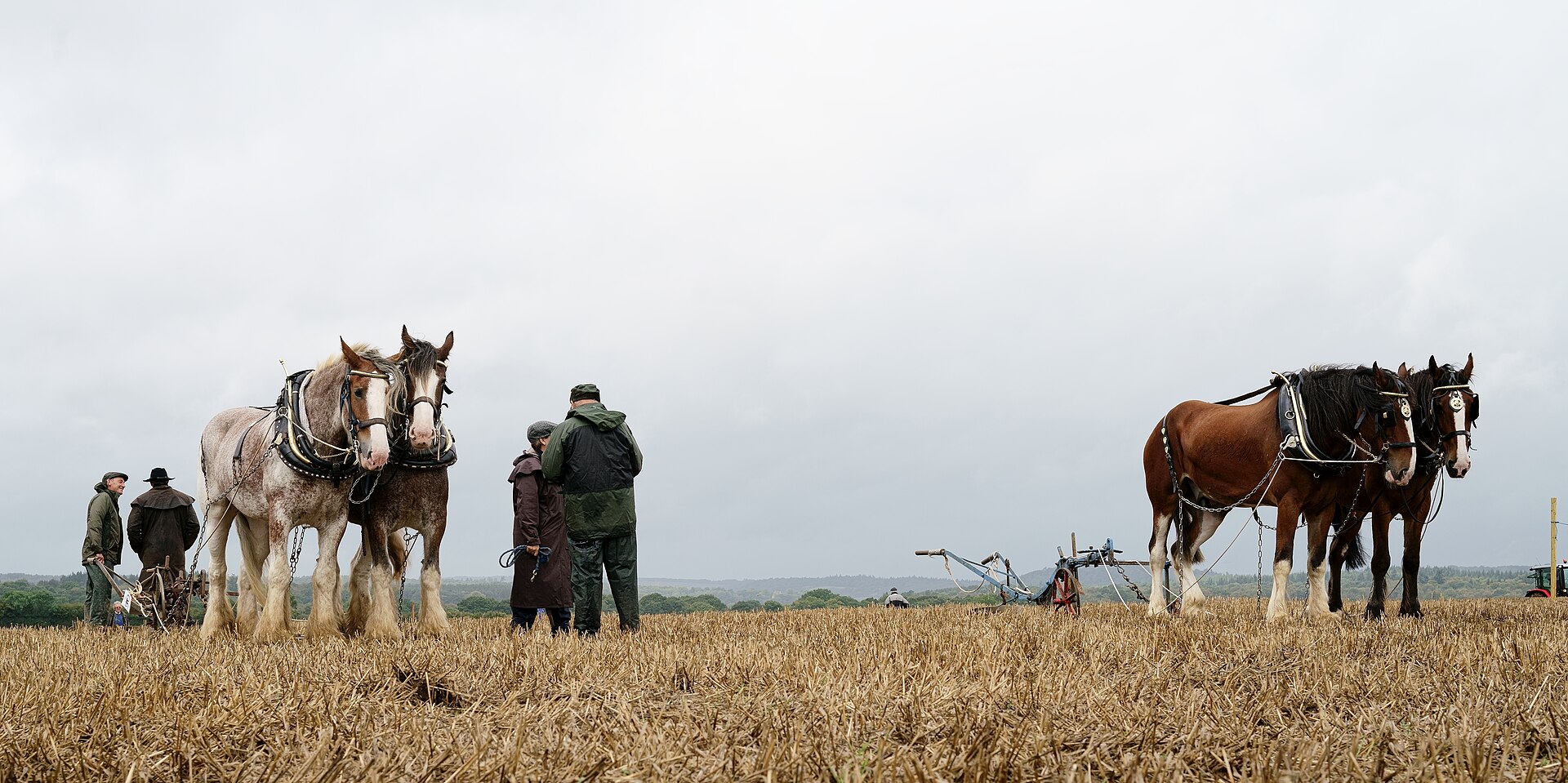
Horse ploughing is a pair of heavy horses, usually Shires, Clydesdales, Percherons or Suffolks, on a general purpose plough, with the ploughman walking behind on the handles. Over a full plot that is miles of walking for everyone involved, so the horses work in bouts with proper rests.
That rhythm is the key to watching them well. Arrive early and you get harnessing-up, which is a spectacle in itself. During work, stand at the headland ends, where the turns happen and where the pairs pause for a breather. Do not crowd the horses or touch without asking, but do ask questions at the rest breaks. Horse ploughmen are, as a breed, delighted to talk.
The Weald of Kent Ploughing Match at Woodchurch on 12 September 2026, its 80th anniversary year, runs horse ploughing alongside modern, vintage and steam classes, plus have-a-go ploughing if watching gives you ideas.
The season, from September stubble to the Nationals and beyond
The season follows harvest. Once the corn is off, the stubbles open up, and the first weekend of September fires the gun: in 2026, Chertsey in Surrey and Romney Marsh in Kent both plough on 6 September. The Saturdays then stack up fast. Weald of Kent on 12 September, the All Wales Ploughing & Hedging Championships at Letterston in Pembrokeshire on 19 September, and the 82nd Northern Ireland International Championships at Royal Hillsborough over 25 and 26 September. The 26th is a monster Saturday in England too, with Essex County, Southwell, Petworth and the FFF&B match all on the same day.
Midweek matches are a thing, pitched at farmers rather than crowds and all the better for it. Mendip, founded in 1858 and in its 168th year, ploughs Marksbury Plain near Bath on Wednesday 30 September, the same day as Cheshire's match on the Cholmondeley Castle Estate, with Brailsford in Derbyshire following on 7 October.
It is all one ladder. Society match wins feed county finals (the Sussex County match at Chiddingly on 3 October brings together winners from the local matches), area finals feed the Nationals (Chertsey hosts a National Vintage area final), and everything lands at Austrey on 10 and 11 October. England mostly stops there. Scotland does not: after the Scottish Championships in late October come Lauderdale in the Borders on 21 November and Stratheden near Cupar on 29 November, ploughing in whatever weather November offers.
Why it costs so little, and the food tent
Most matches are free or a few pounds because they are competitions run by agricultural societies for their competitors, not gate-money shows. The field is lent by a farmer, the stewards are volunteers, and the paying public is a welcome extra rather than the business model. Where there is a charge it is modest: Weald of Kent is £10 in advance or £12 on the gate with under-12s free, East Kent is £12 (cash or card, £10 early bird until 16 September), and even the Nationals is £20 on the gate for adults, less booked online, with children at £2 and free parking.
Take cash regardless. Mendip is cash only with no card facilities at all, and burger vans everywhere prefer notes. The food tent is the social heart of any match: bacon baps early for the competitors, beef rolls and tea urns through the day, and at the shows-attached matches like Southwell and Flintham a proper produce and cookery tent as well. Many matches also pair ploughing with hedge-laying or hedgecutting competitions (All Wales, Cheshire, Cruckton and Brailsford all do), which is where to drift while the judges deliberate. Wear wellies. It is a stubble field in autumn, and it will behave like one.
Quick answers
How much does it cost to get into a ploughing match?
Usually nothing, or under £12. Weald of Kent charges £10 in advance, East Kent £12 on the gate, and even the British Nationals is £20 for adults with children at £2 and free parking. Take cash, some matches (Mendip, for one) have no card facilities.
When is the ploughing match season?
First weekend of September to late October in England, Wales and Northern Ireland, peaking at the British National Championships on 10 and 11 October 2026 at Austrey. Scotland carries on later, with Borders and Fife matches into late November.
Can I have a go at ploughing myself?
Sometimes on the day. Weald of Kent runs have-a-go ploughing at its September match. Otherwise contact your local ploughing society, most are keen for new competitors and will lend kit, advice and a patient eye.
What should I wear and bring?
Wellies or solid boots, a waterproof, and cash for the food tent. Parking is in a field, so allow a few extra minutes if it has rained.
How do I find a ploughing match near me?
TractionAction lists every verified UK match with dates, venues and postcodes. Use the postcode search, or sign up for the Weekly Runsheet email on Thursdays to see what is on within reach that weekend.