How to get the most out of a steam rally
There is a moment at every steam rally, usually mid-afternoon, when a hundred tons of Victorian engineering rolls past in convoy and the ground genuinely shakes. Coal smoke, hot oil, a whistle answering another whistle across the showground. No museum gets close, because at a rally the machines are alive and working, crewed by people who spent all winter in a cold shed getting them ready.
This guide is for anyone who has been once, wandered about a bit lost, and suspects they missed the good stuff. They probably did. Here is how to tell the engines apart, how the day actually runs, why you should stay past teatime, and what that field of enormous engines and loaded trailers at the far end is all about.
Four engines to tell apart
Rally programmes tend to assume you already know the difference. You don't need to, but the day makes far more sense once you can name what is rolling past. Four types cover most of what you'll see.
- Traction engine: the general-purpose workhorse. It hauled the threshing machine from farm to farm, then parked up and powered it from the flywheel with a long belt.
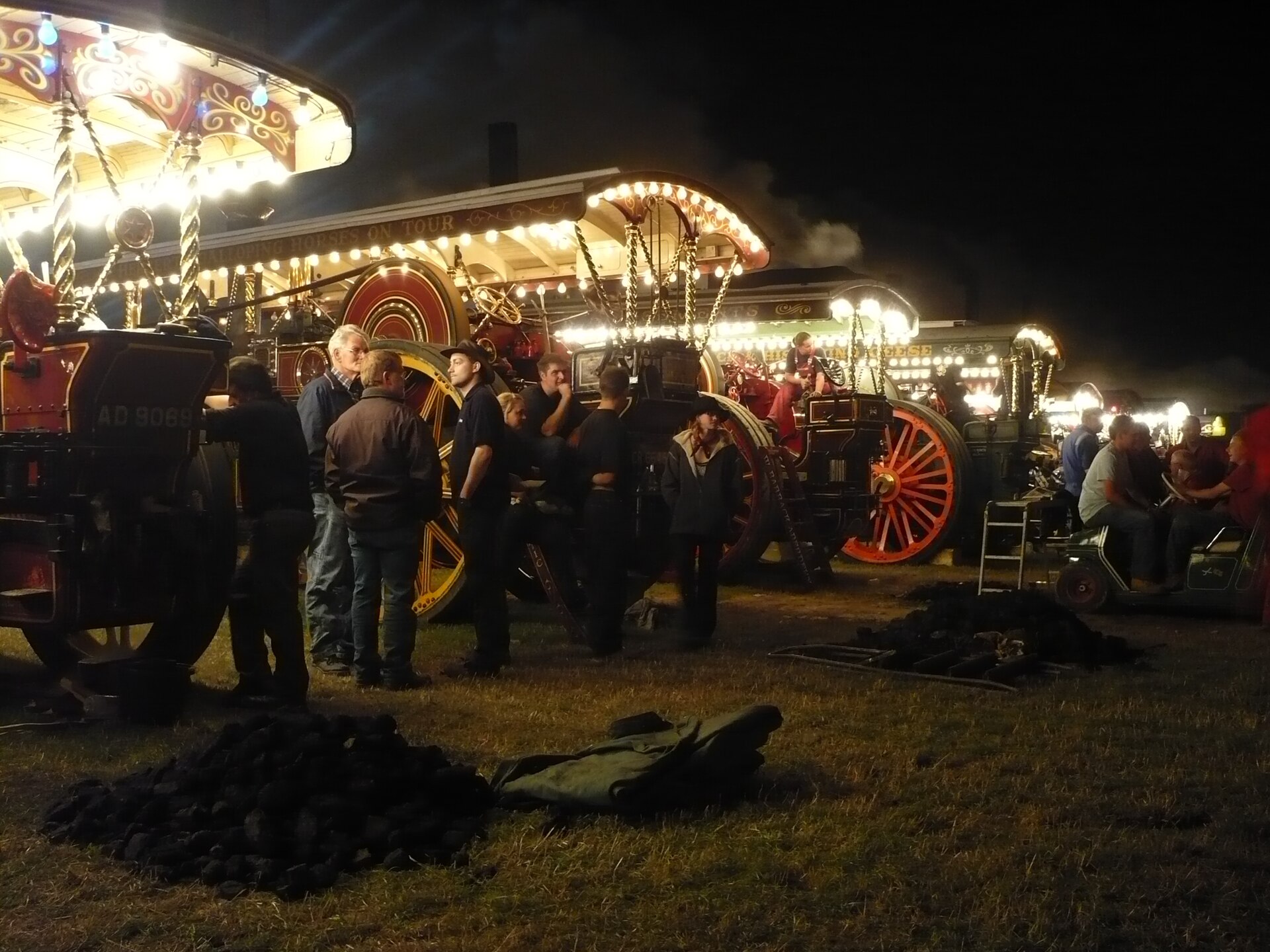
- Showman's engine: a traction engine dressed for the fairground, with a dynamo mounted in front of the chimney to make electricity for the rides and lights. The full canopy, twisted brass and painted lettering are the giveaway.
- Road roller: the same basic machine with a heavy smooth roll instead of front wheels, built for making roads. Some councils were still using them into the 1960s.
- Steam plough (properly a ploughing engine): these worked in pairs, one at each side of the field, dragging a plough between them on a steel cable. The engines never went on the land, which is exactly what you want on wet clay.
How the day runs
Crews light up around dawn. It takes three to four hours to raise steam from cold, so by the time the gates open the yard already smells right. The arena works to a printed timetable, usually one class at a time. Vintage tractors and commercial vehicles tend to get the morning slots, the working demonstrations tick along all day at the edges, and everything builds to the grand parade of steam mid-afternoon, when every engine on the field that can move takes a lap.
That parade is the one item worth planning around. Buy the programme at the gate, find the arena times, and work backwards. At a two-day rally the running order broadly repeats, so missing something on Saturday is not fatal. And listen to the commentary. The boxes are staffed by people who know every engine and owner by name, and half the pleasure is the detail they let slip.
Stay for the evening
Most day visitors drift off around five, which is exactly when a steam rally turns into the best version of itself. At the camping rallies (most of the big two and three-day shows), the engines stay in light steam through the evening. After dark they line up with lamps lit and fireboxes glowing, and the showman's engines do the job they were built for: generating real electricity for the fairground rides beside them. The fair organs, which sound merely loud at 2pm, sound magnificent at 9pm.
Some rallies build their whole identity round this. Masham in North Yorkshire is a steam engine and fair organ rally by name, held in July, and the evening organ music is the point of it. Welland, near Malvern in late July, is known for its evening entertainment and its line of showman's engines lit up at dusk. If you can only do one long day, arrive at noon and stay to the end rather than doing nine till four.
Talking to the crews
Engine crews are, almost without exception, delighted to talk. The etiquette is simple: pick your moment. Someone halfway round with an oil can, or backing twelve tons into a gap, is busy. Someone sat on the footplate with a mug of tea is not.
Good openers: how long does she take to steam up, how much coal does a day like this burn (often a quarter of a ton or more), and where does the engine live the rest of the year. Never climb up uninvited, but do ask, because plenty of crews will wave a child up onto the footplate of a parked engine, and that tends to be the moment a lifelong obsession starts. If you're seriously curious, ask about helping out. Clubs are permanently short of hands and nobody was born knowing how to fire a boiler.
Safety around live steam
A rally is a working environment that lets the public in, and it rewards a bit of sense. Assume every metal surface on an engine is hot, because most of them are. Engines in motion cannot stop quickly and the driver's view past the boiler is poor, so never cut close in front of one, and keep children on the inside of you when one is passing. A long whistle usually means an engine is about to move.
Ear defenders are worth packing for small children, as whistles and organs are louder than you remember. Keep dogs on short leads, watch for hot ash where engines have been standing, and stand well back when a safety valve lifts. None of this means hovering at the rope line all day. It is just the difference between a good day out and a memorable trip to A&E.
The heavy haulage field
At the bigger rallies you'll find a separate section, sometimes a whole field, of road locomotives: the largest engines on the ground, sprung and geared for the road, built to shift loads no horse team could touch. Before low-loaders existed, these hauled boilers, ships' propellers and transformers across the country at walking pace, often with two or three engines coupled to one trailer.
The heavy haulage demonstrations recreate exactly that, with engines double-heading loaded drawbar trailers around a course, and it is the most impressive raw spectacle a rally offers. Look for the living vans coupled behind. The crews genuinely lived in them on the road, sometimes for weeks on a single job. The Bedfordshire Steam & Country Fayre at Old Warden in mid September, now one of the biggest steam gatherings in the country, does heavy haulage properly, and Pickering in early August is worth the trip north for it too.
Practical bits
Wellies or proper boots, always. Rally fields are farmland, and one wet Friday turns the car park into a bog. Bring cash, because the gate, the programme seller and the burger van at smaller rallies may all be cash-only, and rural phone signal is dire. Adult entry typically runs £10 to £15, with children often free or half price. Arrive by late morning if you want to park anywhere sensible.
The season runs from May to the end of September, with July and August the thick of it: Welland and Masham in July, Pickering and Astle Park in August, Shrewsbury over the August bank holiday, and Old Warden as the big finish in September. Every steam rally we can verify is listed on TractionAction with a postcode search, and the Weekly Runsheet email each Thursday flags what is on that weekend, so finding one within an hour of home takes about a minute.
Quick answers
What is the difference between a traction engine and a showman's engine?
A showman's engine is a traction engine fitted with a dynamo in front of the chimney to generate electricity for fairground rides and lights, plus a full-length canopy and far fancier paint and brass. Mechanically they are close cousins.
Are steam rallies good for young children?
Yes, with two provisos: pack ear defenders because whistles and fair organs are genuinely loud, and keep hold of hands near moving engines. Parked engines, the fairground and the miniature section are usually the hits.
How much does a steam rally cost to get into?
Typically £10 to £15 for adults at the established rallies, with children often free or discounted. Smaller club events can be a fiver. Take cash, as some gates and most burger vans do not take cards.
What time of day is best at a steam rally?
Noon until dusk beats an early start. You catch the grand parade of steam mid-afternoon, then the engines lit up and the showman's engines generating for the fair after dark, which is the best part of the whole event.
When is the UK steam rally season?
Roughly May to the end of September. July and August are the peak months, and the Bedfordshire Steam & Country Fayre at Old Warden in mid September is the traditional big finish.